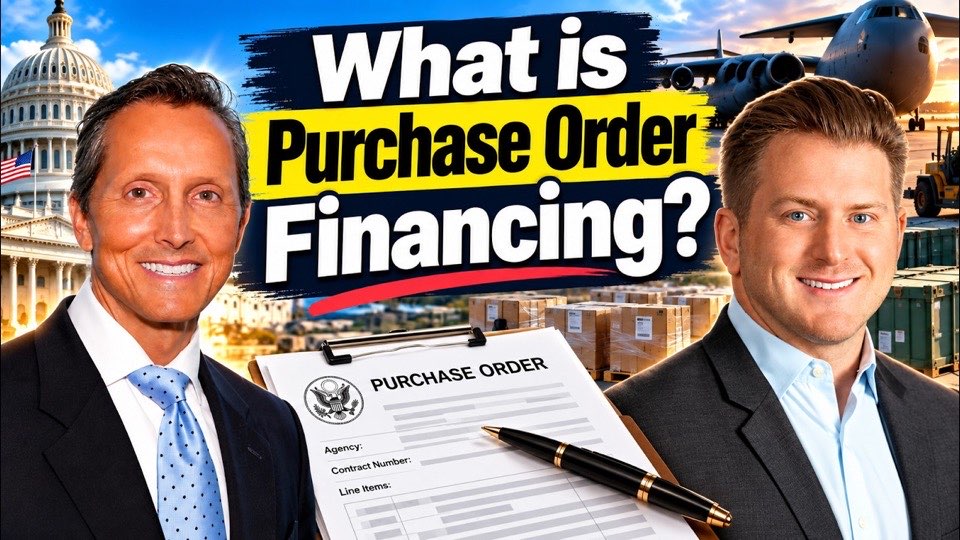
What is Purchase Order Financing?
A purchase order is one of the most common reasons contractors call a lender, and one of the most misunderstood. Tony Gray and Matthew Gillman explain which purchase orders can be financed, how the deal is structured, why it pairs with receivables financing, and why margin decides whether it makes sense.
What is purchase order financing?
Matthew Gillman: It is a financing tool that gives a company the working capital to fulfill a purchase order: an order from the government or another company for a quantity of goods by a date. It is one of the most common calls we get. Often the caller sees the award or the order itself as collateral. But a purchase order only becomes money if you perform it, so whether it can be financed, and by whom, depends on a lot of nuance.
Tony Gray: In the GovCon space a purchase order is usually for a tangible product: servers and routers, tactical gear, a set number of systems.
Which purchase orders are easiest to finance?
Matthew Gillman: Goods that are drop shipped. You are not producing anything; you buy in-stock goods from a large supplier, they leave the warehouse within a week and reach the government soon after. Many lenders will pay the supplier directly, because there is little production or performance risk. It gets harder when an overseas supplier needs a deposit and a final payment before shipping, and the lender starts taking on real performance risk.
Why is financing a manufacturer’s purchase order harder?
Matthew Gillman: Say a $100,000 order needs $30,000 of raw materials, then four to six weeks and $40,000 of labor to produce. You are asking for $70,000, but what you are really asking for is raw material inventory financing and payroll for production. It is tied to a purchase order, but the lender is effectively funding the operations of the business.
Larger companies with diversified revenue make that an easy decision. A standalone order gets complex once you add production time, shipping, and goods built to an exact specification that the government can reject if they are not perfect.
How is a drop-ship purchase order structured?
Matthew Gillman: There is simplicity in it. The payment goes to a large supplier such as Ingram Micro, not a midsize overseas manufacturer. The money is paid to the supplier, the supplier releases the goods, the goods are insured in transit, and they reach the government to be paid for.
Where a supplier wants a down payment for a two-week lead time, purchase order lenders usually want the contractor to make it, as skin in the game. On a $100,000 order with a $30,000 deposit and a $30,000 final payment, you might find a lender to make the final payment once the goods are produced and inspected, so it is not taking the risk until the goods exist.
How does the lender’s risk change along the way?
Matthew Gillman: The further you are from the money, the more risk there is. A down payment to a manufacturer before anything is produced is day-zero money, the highest risk. Once goods are produced and ready to ship, the risk drops. In transit the risk is damage or loss, which should be insured. On delivery the question is whether the goods are accepted: on time, at the right place, what was ordered.
Once they are accepted and the invoice is approved, it is only a question of timing, not of payment. That is where lenders like us like to be involved: solving for timing, not production. A purchase order lender might charge a fixed fee or an interest rate, and the clock usually starts when the goods ship.
Why does purchase order financing pair with factoring or a line of credit?
Matthew Gillman: Once the goods are delivered, the purchase order becomes an invoice, and the money is collected through receivables financing: factoring, an AR line or a contract line. So you either work with a lender that does both purchase order and receivables financing, or with a purchase order lender that only works alongside a receivables lender who controls collections on the back end.
With one or two active contracts there is more concentration, so lenders want more control. A diversified middle market company may see fewer controls.
When should I talk to a purchase order lender?
Matthew Gillman: Before you bid. Some customers call us when a solicitation comes out: here is what I want to bid on, how can you help? That gives them the confidence to bid, even to bid bigger, and to build the cost of capital into the price. Do not assume an award will be collateral you can borrow against.
How much margin do I need to use purchase order financing?
Matthew Gillman: A $150,000 contract with an all-in cost of $135,000 leaves a $15,000 gross margin: 10%. Can that support four months of lead time and the cost of capital? Probably not. Once margins fall below about 15%, outside capital eats whatever is left. Budget and plan before you bid, so you know you have the margin and the capital.
Read more on this
This is an edited version of the conversation: spoken repetition is removed and each answer leads with its point. Every figure and example is as said in the episode. For financing specific to your business, talk to us.
Ready to fund your contract?
No obligation, talk to a govcon financing specialist, not a call center. We'll structure capital around your award.