
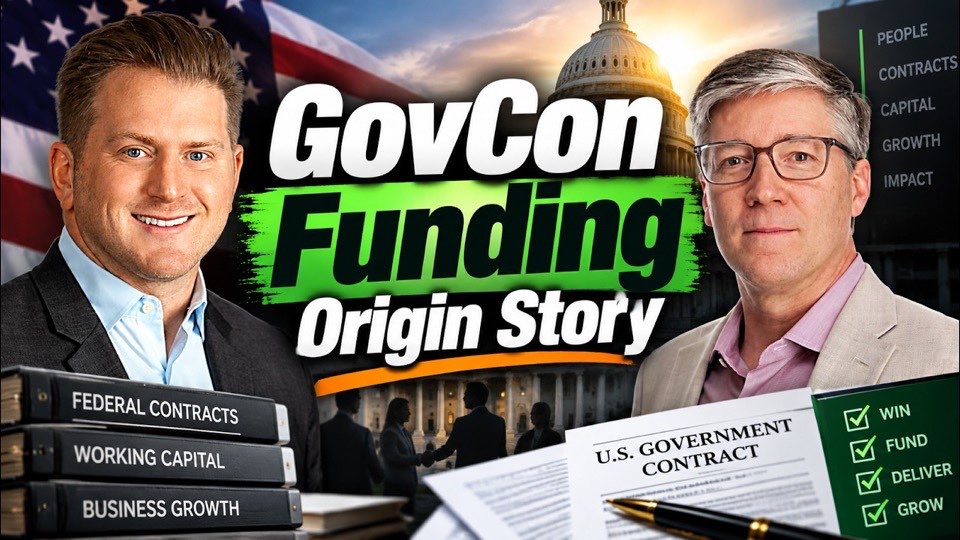
GovCon Funding Origin Story
Co-founders Matthew Gillman and Michael Bagley tell Tony Gray how they got into lending, how bank lending to small businesses changed after 2008, why government contractors got caught in the gap, and why they put their names on the door.
How did Matthew Gillman get into lending?
Matthew Gillman: I fell into it. A junior-year internship with an SBA 7(a) lender in New York turned into a job when I graduated, so from day one I was in business lending. I looked at services companies, product companies, manufacturers and wholesalers, learning credit analysis and how industries were affected by the economy. My career started in 2010, which made for an interesting first look at historical financials from 2007, 2008 and 2009.
What is an SBA 7(a) loan?
Matthew Gillman: It is one of the SBA’s flagship programs: a business term loan, which can include owner-occupied real estate, with terms from about 10 to 25 years. It can fund working capital, debt refinancing, partner buyouts and business acquisitions.
How did Michael Bagley get into lending?
Michael Bagley: I am a banker by trade. I started in traditional commercial banking in Atlanta: conservative, straight commercial lending, nowhere near government. But I am an entrepreneur at heart, so I kept branching out on my own and finding my way back to banking and finance. Then I joined an asset-based lending shop with a federal government focus, and I have stayed in the space ever since.
How has small business lending changed in the last 20 years?
Matthew Gillman: A lot of money has flooded into alternative and non-bank lending. Since 2010 banks have become more restrictive and more cookie-cutter in what they offer small businesses, while alternative lenders and private credit offer a wider range of products: equipment financing, asset-based lending, government contract financing.
Michael Bagley: When I started, you were trained to underwrite with a calculator, you had your own credit authority, and customers knew their banker, who knew the neighborhood and everyone in it. That community feel is gone. Technology moved underwriting to corporate offices and turned branches into transaction centers. Then banks went national. Deposits in a small farming town could end up funding a loan to a customer across the country through an alternative lender’s product. Today lending is faster and national, and AI will be the next disruptor.
Tony Gray: After 2008 banks also took on new regulatory burdens and gravitated to larger, well-established businesses, leaving many others looking to alternative lenders.
How did 2008 change lending to government contractors?
Michael Bagley: When a bank sees a loan going south, it has to downgrade it, and a downgraded loan usually gets pushed out the door. In 2008 I was at an asset-based lending shop with a government focus, and we picked up a huge number of very good customers that had been bankable: A-grade customers knocked down to B.
At the same time government contracting went through sequestration, shutdowns and changes in administration, each shifting where the money is spent. Startups and companies with two to five years of history were being turned down when they walked into their own bank for a line of credit. Shops like ours grew substantially.
Tony Gray: Those were good companies. Their customer was the U.S. government, a very reliable payer, and they were doing work that mattered for national security during two wars. Many did not have pristine financials, but they deserved funding.
What is the white space in small business lending?
Matthew Gillman: A bank’s business banking group might go up to $100,000 or $250,000, and its commercial group might start at $2 million to $5 million. That leaves companies doing roughly $1 million to $20 million in revenue in a white space between the two. That is where we focus.
Another trend: companies that never lent before, like Intuit, PayPal and Toast, now use their payments data to become some of the country’s largest lenders. That gives small businesses more options. But a company growing from a couple of million to $10 million, $15 million or $20 million still wants a person who understands what it does and can say, before it wins a contract, how it can be funded.
Why did Matthew Gillman and Michael Bagley start GillmanBagley?
Matthew Gillman: Michael always says, “it’s all about the people”: customers, employees and us. Michael and I met around 2016, worked at different companies and referred deals to each other. When COVID hit, we decided we trusted each other enough to build a business we knew well and offer better service than anyone else. Money is a commodity. Who you work with, how they work with you and how the product is structured are not. That is why we put our names on the door from day one.
Michael Bagley: The money takes care of itself when people get it on time and in a way that fits their needs. The relationship takes the effort, and expertise is the key.
Why does a government contractor need a lender who knows the industry?
Michael Bagley: A customer walks into a branch with a $60 million award after doing $2 million a year, and the bank has no idea how to deal with it. A lender who knows the business sees a five-year contract, understands they could win another tomorrow, and knows a shutdown can strand money at the payment office. Contracts end, pipelines do not always convert, and a bank covenant can be blown when revenue drops.
We know who the experts are and take a consultative approach. When a company loses a contract and goes from 400 people to 30, holding on to staff to reach the next contract can sink it on payroll. When a big opportunity comes, the structure has to fund it on day one. You cannot do that from a machine. Many customers eventually become bankable, and many stay with us anyway because of the relationship.
Read more on this
This is an edited version of the conversation: spoken repetition is removed and each answer leads with its point. Every figure and example is as said in the episode. For financing specific to your business, talk to us.
Ready to fund your contract?
No obligation, talk to a govcon financing specialist, not a call center. We'll structure capital around your award.